Registering Your Domain: SiteGround vs. a Dedicated Registrar

Some links on this page are affiliate links. If you buy through them, we may earn a commission at no extra cost to you. It never decides what we recommend —read how we make money.
Your domain is the one part of your website you’ll probably keep for as long as the site exists. Hosts, themes, and designs change; the address people type and bookmark shouldn’t. That makes where you register it, and what you’ll pay to keep it, worth a few minutes’ thought.
This guide covers what registering actually does, the choice between registering with your host or a separate registrar, the real costs after year one, and how to pick a name that won’t cause problems later.
What Registering a Domain Does (and Doesn’t)
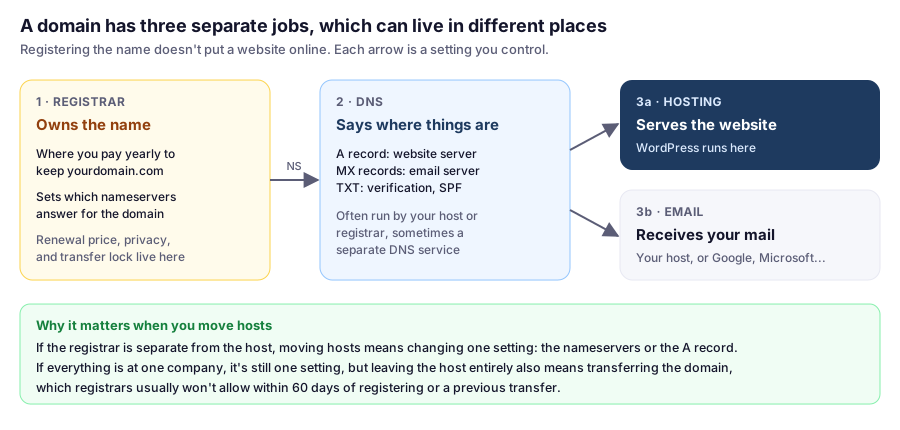
Registering reserves the name for a year at a time. It doesn’t put anything online. Your site appears only when:
- The domain’s DNS points to a web host, through its nameservers or an A record
- That host has a website ready to serve
Keeping those jobs straight is what makes later changes easy. Our DNS guide explains how to see where your DNS lives.
Register With Your Host, or Separately?
| With SiteGround | With a separate registrar | |
|---|---|---|
| Setup | Done at checkout, pointed automatically | Point nameservers or an A record to the host |
| Bills and logins | One account | Two accounts |
| .com cost | $11.99 first year, $22.99/year after; free for the first year with hosting | Varies; compare the renewal price, not the first-year price |
| Privacy | 12 months of domain privacy included | Varies; many include it free |
| Moving hosts later | Change DNS, or transfer the domain out | Change one setting at the registrar |
SiteGround prices checked September 2026. Discounted prices apply to the first invoice only, and the free first-year domain that comes with hosting covers .com, .org, and .net.
Register with your host if you want the simplest setup and expect to stay. Everything is in one place, and the domain is pointed for you.
Register separately if you’d like your domain to stay put regardless of hosting, or you run several sites with different hosts. Moving hosts then never involves the domain at all.
Privacy: What’s Public and What Isn’t
Domain registration details are recorded in public registration databases (often still called WHOIS). Many registrars now hide personal details by default, and domain privacy services replace them with the provider’s details.
SiteGround includes 12 months of free domain privacy with domain registrations. After that, check whether you want to renew it. SiteGround also notes that some country-specific and special extensions don’t support privacy, so check before you rely on it for those.
Whichever registrar you use, keep the contact email on the domain current. Renewal notices and transfer approvals go there, and losing access to it is a common way people lose domains.
Transfers and the 60-Day Lock
If you later want to move the domain to another registrar, you’ll need an authorization (EPP) code from the current one and the domain unlocked. Registrars usually won’t allow a transfer within 60 days of registering the domain or of a previous transfer, so a domain bought today can’t move until then. Transfers of most domains also add a year to the registration, paid at the new registrar’s price.
Picking the Name
A few rules that hold whatever registrar you choose:
- Say it out loud. If you have to spell it for people, it’ll be mistyped. Avoid hyphens, numbers, and words with ambiguous spellings.
- Prefer .com when you can get it. It’s still what most people assume. Other extensions are fine, but check their renewal prices, which can be much higher.
- Check trademarks first. A quick search of your country’s trademark database before registering is cheaper than a forced rebrand.
- Check social handles at the same time, if they matter to your business.
- Think about the long term. A name tied to one product or one city can feel cramped if the business grows.
Protecting a Domain You Care About
- Turn on auto-renew, and keep a valid payment card on file with the registrar.
- Turn on two-step login for your registrar account. Whoever controls that account controls the domain.
- Keep the transfer lock on unless you’re actively moving it.
- Consider registering for several years if you’re sure you’ll keep it, to reduce the number of renewals that could be missed.
FAQ
Should I register my domain with SiteGround or a separate registrar?
Register with SiteGround for the simplest setup if you expect to stay: it's set up at checkout and pointed automatically. Use a separate registrar if you want your domain independent of hosting, so moving hosts never involves the domain.
How much does a .com cost at SiteGround?
SiteGround listed $11.99 for the first year and a regular price of $22.99 a year for renewals when checked in September 2026. A .com, .org, or .net is free for the first year when you buy hosting, then renews at the regular price.
Does SiteGround include domain privacy?
SiteGround includes 12 months of free domain privacy with domain registrations. Some country-specific and special extensions don't support privacy.
Can I move my domain to another registrar later?
Yes, with an authorization code from your current registrar and the domain unlocked. Registrars usually don't allow transfers within 60 days of registration or a previous transfer.
Does registering a domain put my website online?
No. Registering reserves the name. The site appears once the domain's DNS points to a host that has your website ready.
Where This Leads Next
With a domain in hand, the next step is choosing and buying hosting so there’s something for it to point to. If you haven’t picked a host yet, start with our WordPress hosting comparison.